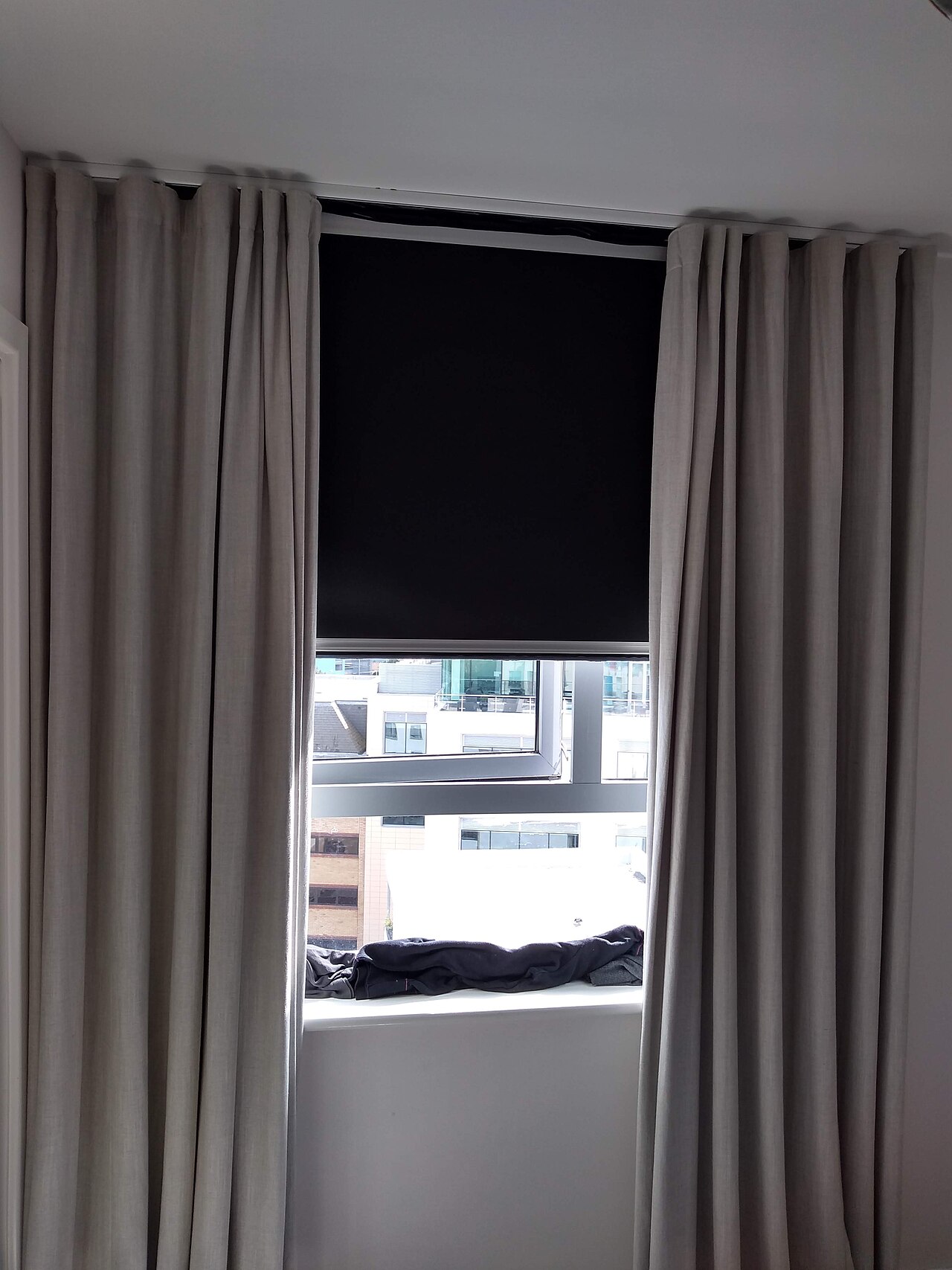
The afternoon sun hits the west-facing windows of a condo on NE 163rd Street around 2 p.m., and you can feel the heat radiating through the glass before you even touch the sill. The AC has been running since noon, but the living room still reads 78 degrees while the thermostat says 74. That gap isn't your imagination — it's solar gain pouring in through uncovered glass, and your system is fighting a losing battle against the sun.
Blackout curtains can cut cooling load by blocking up to 80 percent of solar heat that enters through windows. Hang them close to the glass, extend them past the frame on all sides, and keep them closed during peak sun hours — typically 11 a.m. to 5 p.m. in South Florida — to reduce the temperature at the thermostat by 3 to 5 degrees without touching the AC.
How much heat do windows actually let in?
A standard double-pane window in a North Miami condo lets in roughly 75 percent of the sun's heat energy. On a 92-degree day in July, that west-facing slider can add 1,500 to 2,000 BTUs of heat per hour to a 300-square-foot room. Your 2.5-ton system moves about 30,000 BTUs per hour at full capacity. One unshaded window can eat 5 to 7 percent of your total cooling capacity. Multiply that by three or four windows, and you're asking the compressor to run 20 to 30 percent longer each cycle just to offset the sun.
What makes blackout curtains different from regular drapes?
Regular drapes are fabric — often cotton, linen, or polyester — with an open weave. Light passes through. Heat passes through. Blackout curtains use a tight-weave face fabric bonded to a foam or rubberized backing that blocks 99 percent of visible light and reflects infrared radiation. The backing is the workhorse. It stops the sun's energy at the glass instead of letting it warm the air between the curtain and the window. That air gap matters. When sunlight hits the glass, it turns into heat. If the curtain hangs an inch off the glass, that heat builds up in the pocket and convects into the room. A blackout curtain with a reflective white backing facing the glass bounces the energy back outside before it converts to heat inside.
Where should you hang them for the biggest impact?
Start with windows that face west and south. In North Miami, the sun tracks high and west in summer. A west-facing window on NE 170th Street takes direct sun from 1 p.m. to sunset. South-facing windows on Biscayne Boulevard catch midday sun year-round. East-facing windows matter less after 10 a.m. but still add load in the morning. North-facing windows get almost no direct sun in Florida — skip those. Measure each window. Order curtains 8 to 12 inches wider than the frame on each side and 6 to 10 inches longer than the sill or floor. That overlap seals the edges where heat sneaks past.
How do you install them without damaging walls?
Use a stud finder. Condo walls on Collins Avenue are often metal studs behind 5/8-inch drywall. Plastic anchors rated for 25 pounds will pull out. Toggle bolts rated for 50 pounds hold in metal studs. For concrete block walls in older homes near Oleta River, use 3/16-inch Tapcon screws with a hammer drill. Mount the rod bracket 4 to 6 inches above the window frame and 3 to 4 inches past each side. That height lets the curtain hang flat against the wall without bunching at the top. Use a level. A crooked rod leaves gaps. Hang the curtains on rings with clips or grommets — both slide easily and keep the fabric flat against the wall.
What about the gap at the top and sides?
That gap is where the cooling load sneaks back in. Hot air rises. If the curtain stops at the rod, heat builds in the pocket above and spills into the room. A valance or cornice box seals the top. You can build a simple one from 1x4 pine painted white, mounted to the ceiling with L-brackets. For the sides, magnetic tape on the curtain edge and the wall frame pulls the fabric tight. Velcro strips work too. The goal is a continuous barrier from ceiling to floor, wall to wall. Even a 1-inch gap at the top can let 15 percent of the blocked heat back in.
Can you use them with existing blinds or shades?
Yes, and layering works better than either alone. Cellular shades trap air in honeycomb cells — R-value around 3 to 4. Blackout curtains add another R-1 to R-2. Together they approach R-5 at the window. Mount the shade inside the frame, the curtain outside. Close the shade first, then the curtain. The shade stops the first wave of heat at the glass. The curtain catches what gets past. In a rental near FIU where you can't drill, use tension rods for the blackout layer and leave the landlord's blinds in place. It's not as tight, but it still cuts 50 to 60 percent of the solar gain.
The video walks through hanging blackout curtains step by step: measuring the window, mounting the rod, and sliding the panels on so they sit right. It is a straightforward DIY install focused on getting the curtains up cleanly and evenly. Pair what you see there with the overlap and top-seal tips above — measuring wide, mounting the rod high, and sealing the sides and top are what turn a nice dark room into real cooling-load savings.
When to call us
If you've sealed the windows, added blackout curtains, and the AC still can't hold 74 degrees on a 92-degree afternoon, the problem isn't the curtains. It could be low refrigerant, a dirty coil, undersized ductwork, or a failing compressor. North Miami Air Care serves North Miami and nearby — call (786) 892-8383 and we'll send a tech who checks the whole system, not just the thermostat. Mon-Sat 8AM-8PM.
Our Transparent Pricing
Package A — Diagnostic & Tune-Up
$89.99
System check and coil inspection
Diagnostic evaluation
Honest recommendation
Package B — Full Service
$189.99
Complete system inspection
Coil and filter cleaning
Performance test
Fair-Play Guarantee
$69.99
No-pressure service visit
Clear upfront pricing
Recommendation before any work
Refrigerant
$15.99 per can
Add-on to any service
Priced per can
Keep Your System Running Efficient
Call now for fast, reliable service across the Miami area.