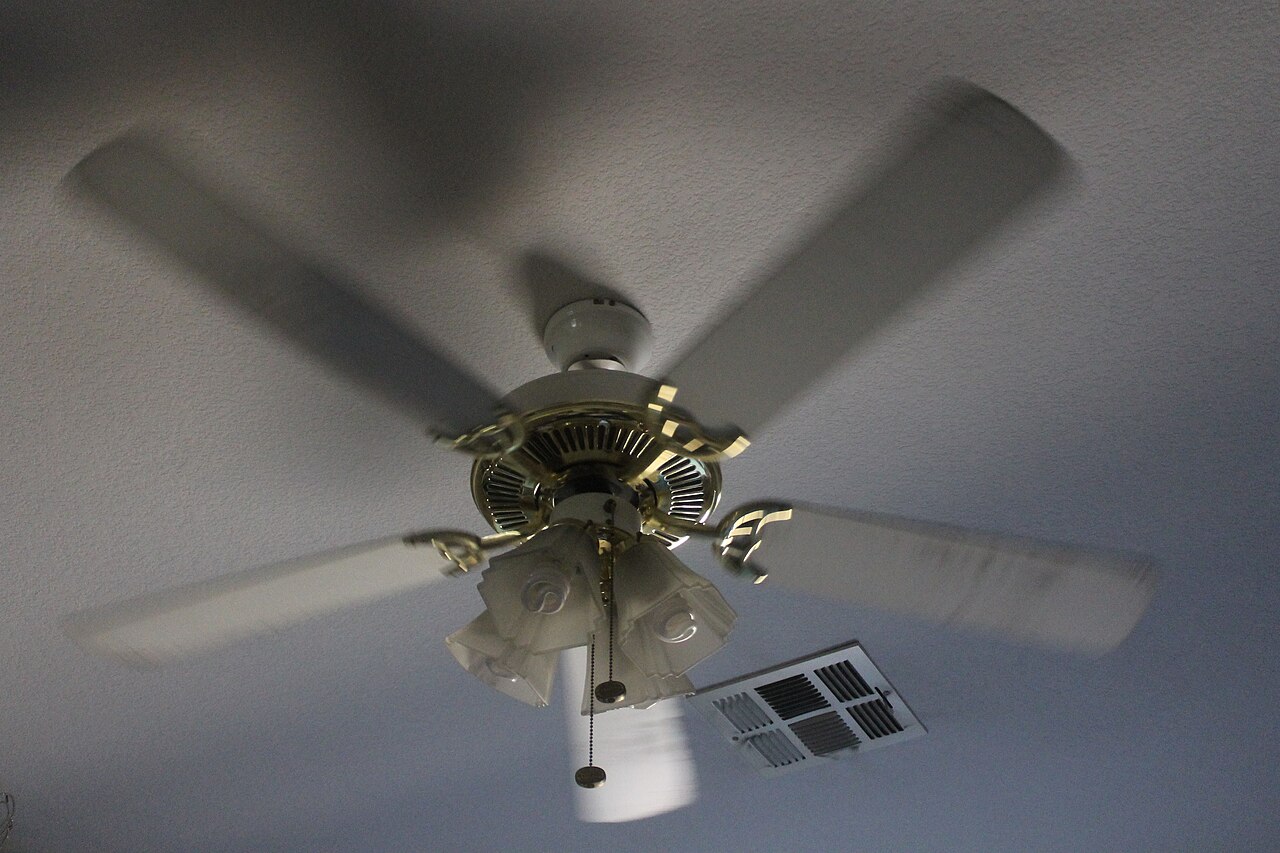
Why does dust on fan blades matter for your air conditioner?
Ceiling fans don't create cold air — they move the air your AC already cooled. When blades carry a layer of dust, every rotation flings fine particles into the room's airflow. Those particles ride the return path back to your air handler, where they stack up on the evaporator coil and the filter. A loaded filter raises static pressure, which means the blower draws more amps and runs longer to deliver the same cubic feet per minute. In a North Miami summer, that extra run time shows up on the electric bill and shortens the life of the blower motor.
Think of your return duct like a straw. When the straw is clean, you sip easily. When it's partially blocked, you suck harder to get the same drink. Your blower is doing that harder suck every cycle.
What supplies do you need for the pillowcase trick?
- One clean cotton pillowcase per room (old ones work fine)
- A step stool or small ladder rated for your weight
- A microfiber cloth for the motor housing
- A vacuum with a brush attachment for the final pass
Cotton grabs dust better than synthetic blends. If you only have polyester cases, they still work — just shake them out outside afterward instead of tossing straight in the wash.
How do you do the pillowcase trick step by step?
- Turn the fan off and wait for blades to stop completely. A spinning blade can catch the fabric and yank the stool out from under you.
- Position your stool so your waist is level with the blades. Overreaching sideways is how people fall.
- Slide the pillowcase over one blade from tip to motor. Hold the open end with one hand, the closed end with the other.
- Wipe firmly from motor to tip. The dust stays inside the case. Flip the case inside-out for the next blade so you're always wiping with a clean surface.
- Repeat for all blades. A five-blade fan takes five passes.
- Take the pillowcase outside and shake it out. Then wash it on hot cycle.
- Vacuum the motor housing and light kit. Use the brush attachment on low suction so you don't bend any fins.
The first blade usually holds the most dust — that's the one that leads into the airflow when the fan runs counterclockwise (summer setting). You'll see a visible line where the dust stops and clean blade begins.
How often should you clean ceiling fan blades in South Florida?
Monthly during cooling season (April through October). In North Miami's humidity, dust sticks faster because moisture makes it tacky. If you have pets or keep windows open during the January "cool front," bump it to every three weeks. A quick visual check — run a fingertip along the blade's leading edge — tells you if it's time. If your finger comes away gray, do it this weekend.
Here's the second way to think about it: your HVAC filter has a MERV rating (usually 8–11 for residential). That filter catches particles down to 3–10 microns. Fan-blade dust is mostly skin cells, textile fibers, and pollen — right in that size range. Every month you skip cleaning the fan, you're asking the filter to do the fan's job.
What about the motor housing and downrod?
Dust on the motor housing acts like a blanket. The motor dissipates heat through its metal shell; a thick layer of dust insulation raises internal temperature enough to break down bearing grease faster and can trip the thermal overload on older units. Wipe the housing with a dry microfiber cloth — never spray cleaner directly on the motor. Liquid near the windings is a service call waiting to happen.
The downrod (the metal pipe connecting fan to ceiling) collects dust too. Hit it with the vacuum brush. If you see rust spots on a downrod in a coastal condo, that's salt air eating the finish — not a cleaning issue, a replacement issue.
Watch the video below for a visual walkthrough of this topic — a companion to the points above.When to call us
If you notice the fan wobbling after cleaning, or hear a new hum or click from the motor, the balance weights may have shifted or a bearing is wearing out. That's not a cleaning fix — it's a mechanical issue that can stress the ceiling junction box. If the motor housing feels hot to the touch after the fan runs ten minutes, or you smell warm plastic or ozone, turn it off at the breaker and call North Miami Air Care at (786) 892-8383. We serve North Miami and nearby, Mon–Sat 8AM–8PM. We'll check the fan's electrical connections, mounting, and motor health.